Suicide
Three Bags FullSuicide is the explanation that overturns the flock’s murder investigation: George did not die because someone killed him, but because he chose not to go on living, and Beth helped stage his death as a murder. The revelation resolves the case while leaving its deepest question open. The sheep learn that humans can separate being alive from wanting to live, but neither Beth’s account nor the evidence at the contest makes George’s final state of mind completely knowable.
From apparent murder to suicide
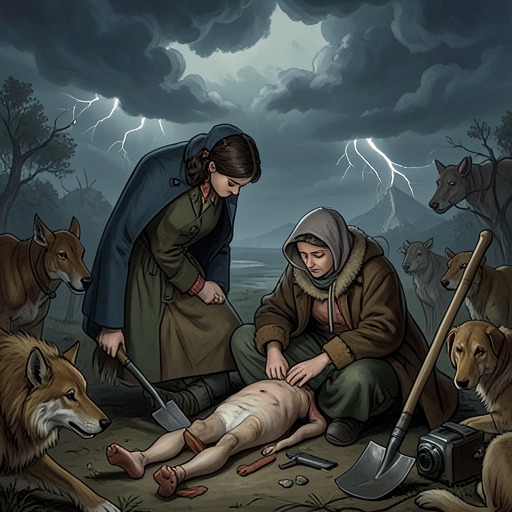
The flock’s understanding changes through a sequence of recognition and resistance. When Fosco identifies George, Zora carefully asks whether George murdered himself. Fosco confirms it, then supplies the word the sheep lack: suicide. The answer makes the familiar evidence—the body, the spade, and Beth’s part in what followed—mean something different. What the sheep had treated as a murder to be solved is revealed as a death deliberately made to look like murder.
Mopple the Whale initially rejects the explanation. He has carried the smelly rag to the Mad Boar in pursuit of the shepherd’s murderer, and accuses Beth of lying to avoid admitting that she killed George. The flock’s sense of Beth’s scent contradicts him: they can tell she is not lying. Their way of judging truth therefore matters at the moment their investigation’s central assumption fails. They do not reach the answer by mastering human motives; they recognize the sincerity of the person telling them that their account of the crime is wrong.
Fosco explains the distinction that unsettles them: humans sometimes look at the world and decide they do not want to live. Mopple objects that living and wanting to live are the same thing. His protest is not simply a failure to learn a definition; it exposes the boundary between the sheep’s understanding of life and the human choice Fosco describes. Suicide becomes a new word whose meaning George himself can no longer explain to the flock.
George’s journey and his isolation
Rebecca’s earlier story gives the revelation an emotional history. In her tale, a girl has two fathers, one secret and one unsecret; she and the secret father remain fond of each other despite the mother’s disapproval. After a quarrel, the girl tries to make him angry, and they do not speak for a long time. A letter eventually says that her father plans to travel to Europe and wants to see her first. The girl hides her joy and keeps him waiting; he waits himself to death. The story gives the sheep a narrative of estrangement, delayed reunion, and a journey desired but never made, though it does not straightforwardly explain every circumstance of George’s death.
Beth connects that deferred journey to George’s last days. George had wanted to go to Europe, but told her that he was afraid and that it was too late. Beth says that she could not give him the courage to continue, and that she helped him do what he wanted. She recalls how, when she gave him the handkerchief, hope was so great that it became hard to bear, while fear grew greater still. In her account, Europe remained a genuine wish, but the prospect of going no longer guaranteed that George could face the journey.
Beth also describes a longer withdrawal: George was lonely, always alone with his sheep, and moved away from everything step by step, toward something black. Her account places his death within a life of isolation and damaged connections, rather than offering one simple cause. It also distinguishes the journey George imagined from what finally happened. The wish to leave for Europe could coexist with fear that he no longer had the courage to go.
Beth’s role and the evidence at the contest
The revelation does not absolve Beth of involvement in the concealment. She acknowledges that she helped George in the way he wanted and describes acting under the fear that otherwise he would not be buried. Her actions had contributed to the appearance of murder, while her account gives the sheep and the human investigators a different explanation for that appearance. The change is consequential: the spade remains part of the case, but it no longer establishes that George was murdered.
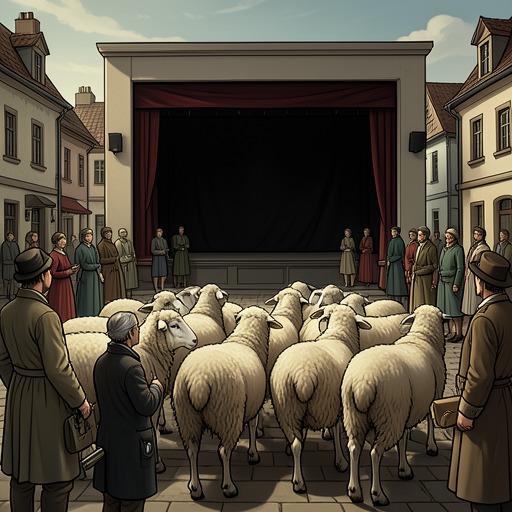
At the Smartest Sheep in Glennkill contest, the staged account allows Inspector Holmes to see how the case fits together. He understands that George died by suicide and that the gray-haired woman was responsible for the business with the spade. The familiar facts—a lonely old man, an eccentric life, a failed marriage, and an absent daughter—seem to him retrospectively plausible as a human explanation. Yet plausibility is not understanding: Holmes recognizes the solution while acknowledging that the reasons cannot truly be understood from those facts alone.
What remains unknowable
Afterward, the sheep still find the suicide mysterious. George was the person who usually explained things in a way they could understand, which makes this human choice especially resistant to their usual confidence in him. His death is therefore both the solution to the investigation and a limit on what the solution can explain. Knowing what happened does not give the flock access to the complete experience that led George there.
Rebecca preserves that uncertainty when she imagines that, until the end, George may have thought he would really go to Europe, before taking a different journey. She becomes tearful as she says it. Her imagining does not cancel Beth’s account of George’s fear or the evidence that he died by suicide; it offers a way of holding together his earlier hope and his final action without pretending to know precisely when one gave way to the other. The flock’s discovery closes the murder mystery, but the meaning of George’s last decision remains partly beyond both human and animal understanding.